The Hard Problem
Human behavior is like weather: pattern analysis at scale, physics at the micro level. We can predict general trends. We can understand the underlying mechanisms. But the complete state of the system remains forever out of reach.
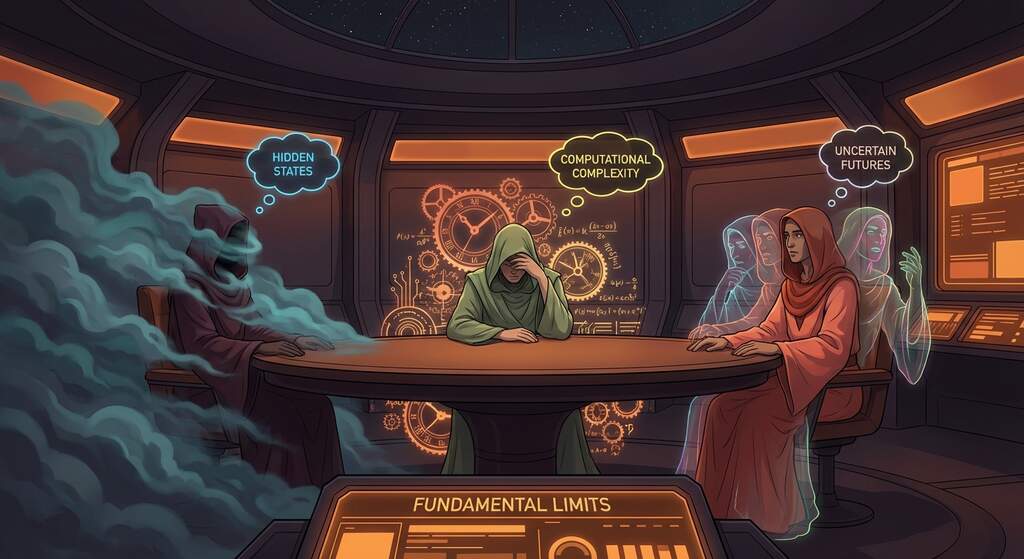
Behavioral systems face three fundamental limits:

1. The state is unknowable
You cannot observe the full internal state of a human mind. Every assessment, every measurement, every self-report gives you a partial, noisy view. The complete truth about someone's psychological state is inaccessible in principle, not just in practice.

2. Even if known, it's intractable
The computational complexity exceeds any realistic budget. Even if you could somehow obtain complete state information, processing it to predict behavior would require resources beyond anything available. The dimensionality is too high; the interactions are too complex.

3. There is no state machine
Psychology is not deterministic mechanics. There is no ground truth to converge on. Two identical situations can produce different behaviors; the same person responds differently at different times. Randomness and irreducible uncertainty are built into the system.
These are not limitations of current technology. They are fundamental constraints that any behavioral modeling approach must acknowledge.
Who Faces This Problem
These challenges affect every field that deals with human behavior:
- Economics models rational actors, but real people are emotional, inconsistent, and context-dependent
- Sociology studies groups, but group dynamics emerge from individual psychology
- Political science predicts voting, but voters are swayed by mood, relationships, and identity
- Organizational behavior designs systems for humans who do not behave as designed
- AI development creates agents that lack persistent personality and emotional coherence
All these domains need simulation tools that embrace uncertainty rather than pretend it away.
Who We Are
Behavioral Pathways is a research organization dedicated to building computational tools for behavioral simulation. We are not trying to solve the hard problem - that would be hubris. We are building tools that work within its constraints.
Our approach is grounded in established psychological theory and empirical research. We do not invent new psychology. We integrate validated frameworks into computational systems that respect their insights while making them queryable and composable.
What Drives Us
We believe that better behavioral models can improve:
- AI systems that need persistent, coherent personality
- Simulation platforms for training, research, and policy analysis
- Game characters that feel like real people with real histories
- Research tools for computational psychology and social science
The goal is not to predict individual behavior with certainty. That is impossible. The goal is to produce behavior that is plausible, consistent, and grounded in how people actually work psychologically.
Our Philosophy
Build tools that embrace uncertainty rather than pretend it away.
We model distributions, not point estimates. We track confidence and decay. We represent what we do not know as explicitly as what we do. This epistemic humility is not a weakness - it is the only honest approach to modeling systems we cannot fully observe.