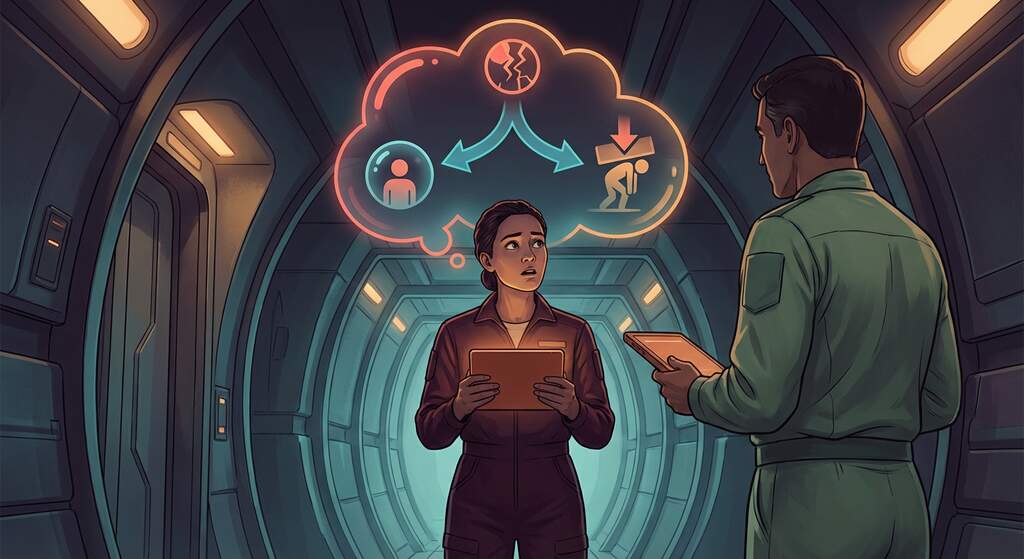
Some events map to more than one ITS pathway. For example, prolonged financial strain can increase both Thwarted Belongingness (TB) and Perceived Burdensomeness (PB). This example shows how to model a single complex event and see multiple pathways move together.
The Scenario
An employee experiences sustained financial strain after a job disruption. The event affects their sense of belonging at work and increases perceived burden on family. We track both pathways without creating two separate events.
Step 1: Create the Event
use behaviorsim_rs::entity::EntityBuilder;
use behaviorsim_rs::enums::{EventPayload, EventType, LossType, Species};
use behaviorsim_rs::event::EventBuilder;
use behaviorsim_rs::simulation::Simulation;
use behaviorsim_rs::types::{Duration, EntityId, Timestamp};

let sam = EntityBuilder::new()
    .id("sam")
    .species(Species::Human)
    .age(Duration::years(31))
    .build()?;

let reference = Timestamp::from_ymd_hms(2024, 1, 1, 0, 0, 0);
let mut sim = Simulation::new(reference);
sim.add_entity(sam, reference);

let sam_id = EntityId::new("sam").unwrap();
let financial_strain = EventBuilder::new(EventType::ExperienceStrainFinancial)
    .target(sam_id.clone())
    .severity(0.8)
    .payload(EventPayload::Loss {
        loss_type: LossType::Resource,
    })
    .build()?;
Step 2: Check Pathway Coverage
use behaviorsim_rs::processor::compute_its_factors;
use behaviorsim_rs::types::Timestamp;

let event_time = Timestamp::from_ymd_hms(2024, 2, 5, 0, 0, 0);
sim.add_event(financial_strain, event_time);

let handle = sim.entity(&sam_id).unwrap();
let state = handle.state_at(Timestamp::from_ymd_hms(2024, 3, 1, 0, 0, 0));
let factors = compute_its_factors(state.individual_state());

println!("TB: {:.2}", factors.thwarted_belongingness);
println!("PB: {:.2}", factors.perceived_burdensomeness);
println!("AC: {:.2}", factors.acquired_capability);
Why This Matters
- Single source of truth: One event carries the full psychological interpretation.
- Accurate risk modeling: Multi-pathway events accelerate convergence.
- Cleaner simulation logs: No duplicate events needed.
Use multi-pathway events for real-world situations that simultaneously impact belongingness and burdensomeness, like financial strain, prolonged isolation, or relationship disruption.