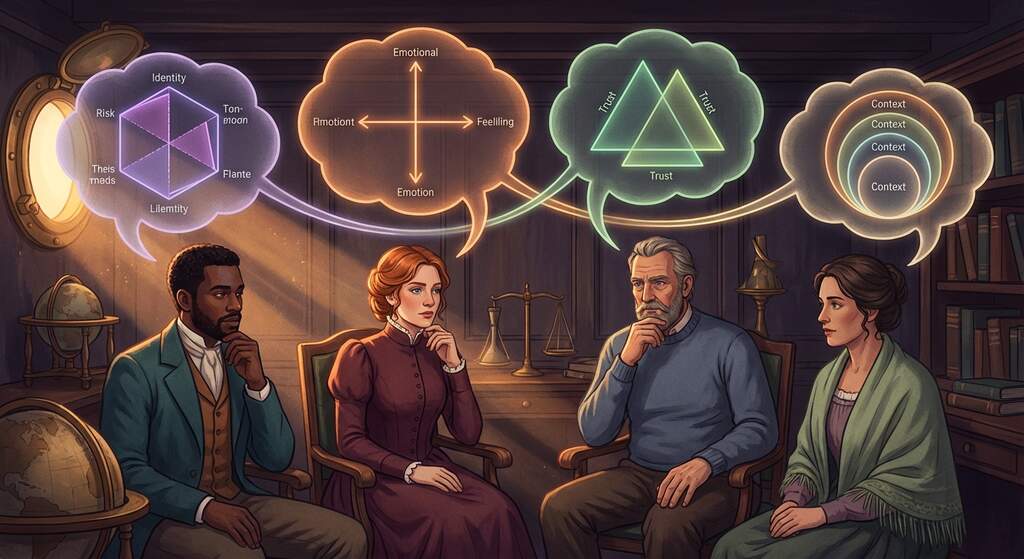
Behavioral Pathways does not invent new psychology. Instead, we integrate established theoretical frameworks into a computational system that respects their original insights while making them queryable and composable. Each theory addresses a different aspect of human psychology; together, they form a comprehensive model of how people think, feel, and behave.
Why These Specific Frameworks?
We selected these six frameworks because they meet three criteria:
- Empirical validation: Each has substantial research support and predictive validity
- Computational tractability: Each can be expressed as measurable dimensions or discrete states
- Complementary scope: Together, they cover personality, mood, relationships, development, and context without significant overlap
Many psychological theories are too vague for computation, too narrow for general simulation, or too controversial to stake a system on. The frameworks we chose balance rigor with breadth.
The Six Frameworks

HEXACO: Who You Are
The Six Factors
Honesty-Humility, Emotionality, Extraversion, Agreeableness, Conscientiousness, Openness to Experience
HEXACO is a six-factor model of personality that emerged from lexical studies across multiple languages. Unlike the Big Five, it includes Honesty-Humility as a distinct factor, which proves critical for modeling trust, deception, and ethical behavior.
In Behavioral Pathways, HEXACO serves as the interpretation filter. The same event affects different entities differently based on their personality profile. A rejection processed through high Emotionality creates larger mood deltas than the same rejection processed through low Emotionality. Events are not applied uniformly; they are interpreted through who you are.
PAD: How You Feel
The Three Dimensions
Pleasure (valence), Arousal (activation), Dominance (control)
The Pleasure-Arousal-Dominance model represents emotional states in a three-dimensional space. Rather than modeling discrete emotions (happy, sad, angry), PAD captures the underlying dimensions that all emotions share.
This approach has two advantages for simulation: it avoids the ontological debates about emotion categories, and it allows for smooth interpolation between states. In our system, mood is always a PAD coordinate that shifts continuously based on events, never jumping discretely between labeled states.
ITS: Risk Assessment
Core Constructs
Thwarted Belongingness, Perceived Burdensomeness, Acquired Capability
The Interpersonal Theory of Suicide provides a framework for modeling psychological risk states. Its constructs, particularly thwarted belongingness (feeling disconnected) and perceived burdensomeness (feeling like a burden), extend naturally to modeling general distress and social disengagement.
We use ITS not just for risk modeling but as a general framework for understanding how social connection and perceived contribution affect wellbeing. When an entity's belongingness drops below threshold, their behavior patterns shift toward withdrawal and disengagement, even if the context is a game character rather than clinical simulation.
PPCT: Development Over Time
The Four Elements
Person, Process, Context, Time
Bronfenbrenner's Process-Person-Context-Time model provides the developmental backbone of our system. It emphasizes that development happens through regular, bidirectional interactions between the person and their environment, accumulated over time.
In computational terms, PPCT justifies our two-pathway model: short-term deltas (Process) and long-term base shifts (accumulated change over Time). It also grounds our approach to formative events, where severe experiences can permanently shift baseline traits, not just create temporary deviations.
Ecological Systems: Context Layers
The Five Systems
Microsystem, Mesosystem, Exosystem, Macrosystem, Chronosystem
Bronfenbrenner's ecological systems theory describes five nested layers of context that influence development. The microsystem is immediate relationships; the macrosystem is cultural values; the chronosystem is historical time.
We implement this as a context stack. When computing state, we consider not just the immediate event but the relationship context (microsystem), the intersection of different relationship domains (mesosystem), external systems that indirectly affect the entity (exosystem), and broader cultural/environmental parameters (macrosystem). This allows the same event to have different effects depending on where it occurs in the entity's life structure.

Mayer's Trust Model: Relationships
Trustworthiness Components
Ability, Benevolence, Integrity
The Mayer model decomposes trust into three components: Ability (can they do what they claim?), Benevolence (do they care about me?), and Integrity (do they follow principles I can accept?). This is not general "trust" but domain-specific trustworthiness.
In Behavioral Pathways, each relationship tracks ABI scores separately. An entity might trust their doctor's ability without trusting their benevolence. They might trust a friend's intentions without trusting their competence. This decomposition allows nuanced relationship modeling rather than simple friend/enemy or high-trust/low-trust binaries.
How They Work Together
These frameworks are not independent modules bolted together. They form an integrated system where each informs the others:
An event occurs in a context (Ecological Systems). The entity interprets it through their personality (HEXACO). The interpretation creates mood shifts (PAD) and potentially trust changes (Mayer) toward involved parties. Over time (PPCT), accumulated events either decay away or, if severe enough, shift baseline traits. Throughout, we track risk indicators (ITS) that emerge from the interaction of all these factors.
Consider a specific example: an employee receives harsh criticism from their manager.
- Context (Ecological): This is a microsystem event in the work domain
- Interpretation (HEXACO): High Emotionality amplifies the negative impact; high Conscientiousness might trigger self-blame
- Mood (PAD): Pleasure drops, arousal increases (stress), dominance drops (feeling powerless)
- Trust (Mayer): Manager's Benevolence score decreases; Ability score might increase if the criticism was accurate
- Risk (ITS): If this pattern repeats, belongingness at work decreases
- Development (PPCT): Single event creates a decaying delta; repeated pattern might shift baseline anxiety
What We Don't Model
No framework models everything. Notably absent from our approach:
- Cognitive processes: We don't simulate reasoning, decision-making, or memory in detail. We model the emotional/personality layer that colors those processes.
- Psychodynamic factors: We don't model unconscious conflicts, defense mechanisms, or early childhood fixations. These are too poorly specified for computation.
- Specific disorders: We model dimensional variation, not categorical diagnoses. We can represent high anxiety, not "Generalized Anxiety Disorder."
These are deliberate scope limitations, not oversights. A system that tries to model everything models nothing well.
Implications for Use
Understanding the theoretical foundations helps users work with the system appropriately:
- When configuring entities, set HEXACO traits thoughtfully. They determine how everything else unfolds.
- When designing events, consider which trust components they affect. Betrayal and incompetence are different.
- When interpreting results, remember that state is always contextual. The same PAD values mean different things at work versus at home.
- When validating behavior, compare against the source theories. Our system should produce outputs consistent with their predictions.
The theoretical grounding is not just academic background. It is the specification. When behavior seems wrong, the question is: which theory is our implementation violating?